From PaaS to Bare Metal – My First Production Deployment
From PaaS to Bare Metal – My First Production Deployment
The Context
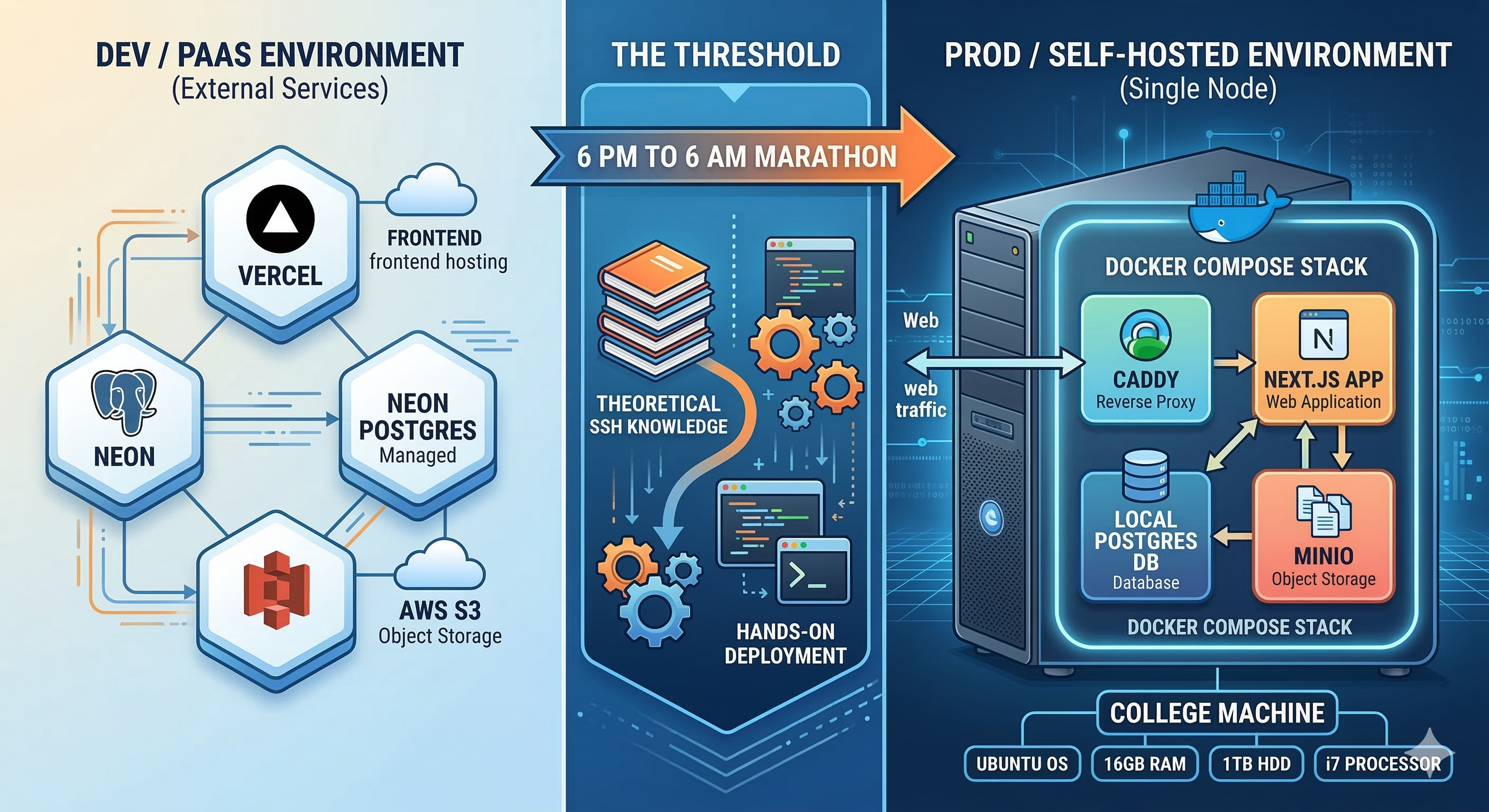
After years of relying on Platform-as-a-Service (PaaS) providers for my projects, I finally moved a production-level application (a college-specific system) onto a dedicated local server. I went from "theoretical knowledge" of SSH and EC2 to managing a physical i7 machine with 16GB RAM and 1TB storage on the college intranet.
The Realization
The biggest realization wasn't just how to ssh into a box, but the architectural shift required when moving from cloud-native managed services (S3, Neon Postgres) to self-hosted equivalents (MinIO, local Postgres) within a single machine.
Technical Challenges & Solutions
1. Environment-Agnostic Storage & DB
In development, I used Neon Postgres and AWS S3. For production, to utilize the 1TB of local storage and avoid costs, I shifted to MinIO and a local Postgres instance.
- The Fix: I implemented a toggle system using environment variables. The application logic switches between S3/MinIO and Neon/Local PG drivers based on the
NODE_ENV. - The Data Migration Caveat: Migrating data via
pg_dumpbrought over S3 signed URLs. I had to script a transformation to convert those hardcoded cloud links into local MinIO routes.
2. Containerization with Docker Compose
To make the system "one-click" deployable and manageable for the future, I wrapped everything into a docker-compose.yml:
- App Service: A custom Docker image of the Next.js app.
- Database: A Postgres container.
- Storage: A MinIO container for S3-compatible object storage.
- Reverse Proxy: Used Caddy to handle incoming traffic on Port 80 and route it to the Next.js app (Port 3000) and MinIO public routes.
3. The Network Setup
- Initial Physical Contact: Installed Ubuntu and enabled
sshd. - Remote Management: Once the SSH server was live, I retreated to my hostel room. Since the server and my laptop were on the same intranet, I managed the entire 12-hour deployment (6 PM to 6 AM) remotely.
Key Takeaways
- Caddy > Nginx (for speed): Caddy’s simplicity for reverse proxying is unmatched when you need to get up and running quickly.
- Production != One-off: Deployment isn't just about making the site "visible"; it's about building a scalable system where versioning and service dependencies are handled automatically (hence Docker).
- Intranet Security: Since this is an internal college tool, HTTP over Port 80 was acceptable, but it taught me the importance of internal routing.
Current Stack
| Service | Development | Production (Self-Hosted) |
|---|---|---|
| Framework | Next.js | Next.js (Dockerized) |
| Database | Neon Postgres | Postgres (Docker) |
| Object Storage | AWS S3 | MinIO |
| Gateway | Vercel | Caddy (Reverse Proxy) |