From PaaS to Bare Metal – Part 2: The Updation Challenge
Part 2 – The "Day 2" Challenge: Updates and Blue-Green DB Sync
The Context
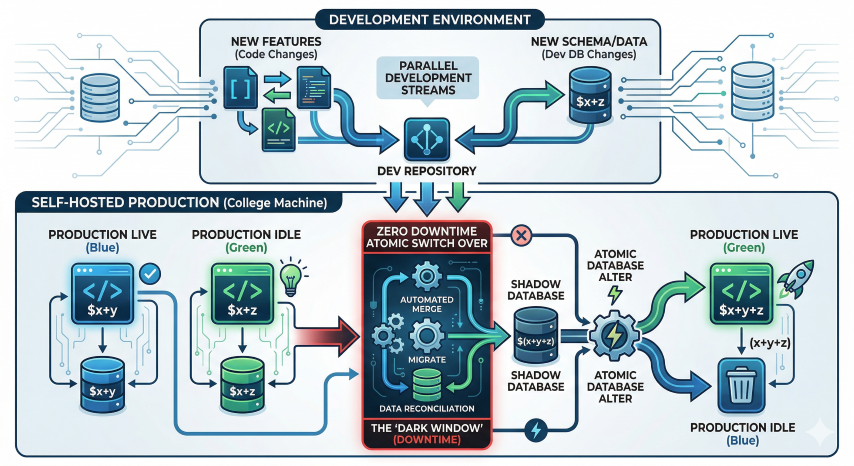
Once the initial deployment was live on the college machine, the real challenge began: Evolution. We were constantly adding features and gathering new production data (x+y). Meanwhile, in the development environment, I was generating new schema changes and seed data (x+z).
The goal: Update the production environment to (x+y+z) with minimal downtime and zero data loss.
The Strategy: Manual Blue-Green Migration
Since I was working on a single bare-metal machine without a managed RDS, I couldn't just click "Restore." I had to orchestrate a manual Blue-Green swap for the database.
1. The Storage Sync (MinIO)
Syncing media was the "easy" part. I used a specialized minio-init container equipped with the mc CLI (MinIO Client).
- The Process: On container start, it performs a
mirrorfrom S3 to the local MinIO instance. - The Result: It keeps existing production data
(x+y)and adds new dev assets, ensuring no overwrites or deletions.
2. The Database Merge (x + y + z)
Merging databases is trickier than syncing files because of primary keys and schema constraints.
- The Shadow DB: I created a "Shadow" (Green) database instance alongside the live "Main" (Blue) database.
- The Sync: 1. Dumped the live production data
(x+y). 2. Merged it with the new development SQL dump(x+z). 3. Restored this merged(x+y+z)dataset into the Shadow DB. - The Switch: Once the Shadow DB was verified, I took the app down for a brief window, renamed/altered the databases so the app pointed to the new
(x+y+z)version, and brought the app back up.
Lessons Learned
- Downtime vs. Integrity: Taking the app down briefly during the
ALTER DATABASEcommand ensures that no new data (y') is written to the old DB while you are switching to the new one. - Atomic Switches: Renaming databases in Postgres is nearly instantaneous, making the "Dark Window" incredibly small.
- Schema Evolution: This manual process highlighted why automated migration tools (like Prisma or Drizzle) are essential as projects scale.
Future Roadmap: Staging & CI/CD
Managing this manually overnight is a great learning experience, but not sustainable. My next steps for this infrastructure are:
- Staging Environment: A mirror of production to test these Blue-Green swaps before touching the live data.
- GitHub Actions / CI-CD: Once the college provides a Public IP and Domain, I will automate the deployment pipeline to handle these updates via runners.