[ BACK_TO_LIBRARY ]
Architecture
System Design Patterns — Quick Patterns Reference
2026.04.30
6 min
Quick Overview
This TIL captures five foundational system-design patterns I sketched while watching a short video and transcribing the Excalidraw notes: 1) Monolith vs Microservices, 2) Database-per-Service, 3) Cascading Failure & Circuit Breaker, 4) Event Sourcing, and 5) CQRS.
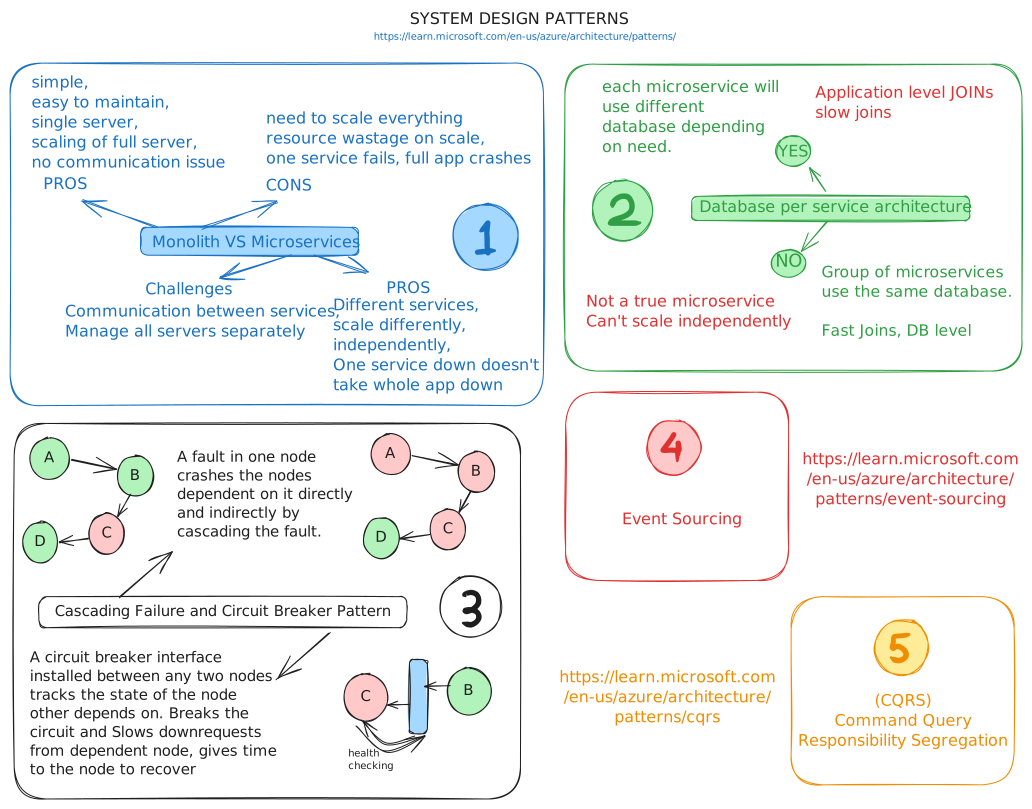
1. Monolith vs Microservices
- What: Trade-off between a single deployable application and a set of independently deployable services.
- Pros (Monolith): Simple to develop, single server/process boundary, easy local debugging.
- Cons (Monolith): Must scale whole app for one hot component; team velocity can be constrained.
- Pros (Microservices): Different services scale independently, can use different stacks and DBs, failure is more contained.
- Challenges: Service communication, distributed tracing, increased operational complexity.
When choosing, weigh team size, operational maturity, and latency/cross-service transaction costs.
2. Database per Service
- What: Each microservice owns its own datastore and schema; services do not share a single database.
- When to use: When strict service autonomy and independent scaling are primary goals.
- Caveats: Application-level joins across services are expensive; design APIs for denormalized reads or use eventual consistency patterns.
Decision flow (simplified):
- If services need fast DB-level joins, a shared DB might be tempting — but it couples deployments.
- Prefer grouping highly coupled components or use a shared read-side for queries.
3. Cascading Failure & Circuit Breaker Pattern
- Problem: A fault in one node can cascade, causing dependent nodes to overload and fail.
- Circuit Breaker: A proxy/sidecar or library detects repeated failures and opens the circuit to stop requests, returning a fast failure or fallback until the downstream recovers.
Pseudocode (conceptual):
Code Block
if failure_rate(service) > threshold:
  open_circuit(service)
  return fallback_response()
else:
  route_request()
- Benefits: Prevents overload, gives time for recovery, reduces error amplification in the system.
4. Event Sourcing
- What: Persist state changes as an immutable sequence of events instead of storing only the current state.
- Benefits: Complete audit log, easy to rebuild state, great fit for domain-driven designs requiring history.
- Trade-offs: Increased complexity for queries (need projections), eventual consistency, event versioning concerns.
5. CQRS (Command Query Responsibility Segregation)
- What: Separate write model (commands) from read model (queries). Often paired with Event Sourcing.
- Benefits: Optimized models for reads and writes independently; read side can be denormalized for performance.
- Caveats: Additional operational complexity keeping read projections up-to-date; handling eventual consistency in the UI.
Results / Personal Notes
- These patterns are complementary: Event Sourcing + CQRS form a strong pair for write-heavy or audit-sensitive domains. Circuit breakers and DB-per-service help keep microservices robust and autonomous.
- For small teams or early-stage projects, start with a modular monolith and extract services when you need independent scaling or clear ownership boundaries.
🧭 Connectivity Logic
| Pattern | When to use | Result in system |
|---|---|---|
| Monolith | Small team, tight coupling | Fast iteration, simple ops |
| Microservices | Independent scaling, large teams | Isolated failures, more infra |
| DB-per-Service | Strong service ownership | Fewer cross-team DB conflicts |
| Circuit Breaker | Unreliable downstreams | Limits blast radius |
| Event Sourcing + CQRS | Audit, complex domain | Powerful auditing, projection needs |
System note: These are practical summaries — choose patterns that match team maturity and operational constraints.
#system-design#patterns#microservices#devops